

Salvation from the snow for Rome’s homeless
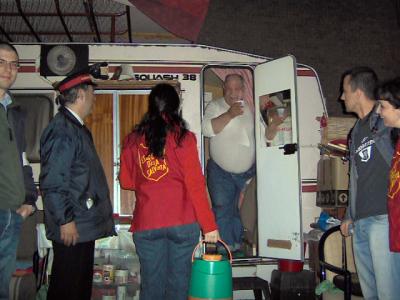
ROME -- It’s a cold Sunday night in early February, one of the busiest nights of the year for Rome’s Salvation Army, known in Italy as the Esercito della Salvezza.
Upon arrival at their headquarters in San Lorenzo, towards the North of the city, I ask where I might find Massimo Consentino, coordinator of the Rome Winter aid programme (Soccorso Invernale) which offers relief to people living rough on the city streets during the coldest months. Expecting to be directed to a man in military-style uniform at a desk, I am surprised to be shown into the kitchen, where I find a man in a blue fleece bent over an industrial pot of pasta sauce.
Along with some 20 volunteers ranging from the ages of 19 to 80, Massimo is busy preparing hundreds of meals for both the homeless people who’ve turned up at the shelter tonight and those still on the streets, just a small proportion of the estimated 1600 in Rome alone, (6000 including gypsy camps). Later, he and a team of volunteers will pack their cars with pasta (with a spicy tuna sauce), cheese sandwiches and steaming hot tea and go in search of those in need.
Co-founded 20 years ago by Massimo Consentino, the Winter aid programme used to be focussed exclusively around the vast Termini station, which notoriously attracts the homeless. Every night, he and his colleagues would distribute meals there. Over the years, however, about 30 other charitable organisations have also pitched in, leaving the Salvation Army free to try to “fill in the gaps.”
Every Wednesday and Sunday from November until March, the Winter aid team distributes not just food and drink, but also blankets and clothes. However, over the last month, as Rome has been crippled by Arctic temperatures and the heaviest snowfalls the city has seen for decades, the team has often had to work six days a week.
Their organisation, founded by British Methodist preacher William Booth, is still very much in touch with its Christian roots. “We are a church and people know that,” explains Massimo, “but, beyond the work of the church itself, there is also social work.”
These days, the Salvation Army in Rome welcomes volunteers regardless of their religion or nationality and the homeless people they help come from all around the world. Over the decades, however, Massimo has noted a shift in the geography of the city’s homeless: “They used to be many North Africans (Egypt, Morocco, Libya etc). Nowadays, there are people from all over the world, especially from Eastern Europe.” Significantly, Massimo also notes a recent increase in the number of homeless Italians, a reflection on the peninsula’s troubled economy.
Although the Salvation Army is perhaps best known around the world for their uniform, the Italian organisation can only wear it for church services and ceremonies. A law passed under Berlusconi’s government has forbidden members from wearing them out in public because of their similarity to police uniforms. “People used to run away when they saw us coming!” Massimo admits. That’s why all the volunteers in the shelter – some from as far afield as the USA, Portugal and Tunisia – are all wearing homely red aprons adorned with the traditional Salvation Army logo.
In the canteen, there’s a wider selection of food to choose from, including veal, sausages, eggs, potatoes and omelette. Unlike the shelters offered by the Italian government, which are badly heated (if at all) and few and far between, the Salvation Army’s shelters are well-maintained and offer each guest his or her own private room.
Is their work strictly necessary? After all, over the last few weeks, the mayors of Rome and Milan have opened up the metro stations at night to allow the homeless to take shelter there.
“But they they open at 11pm - and at 4am, they send them away,” Masssimo points out. “At 4am, when it's minus six degrees outside, what are you supposed to do? Where are you going to go?”
As well as providing emergency relief, the centre has helped many to get back on their feet. One former regular at the shelter went on to become a barman and is currently volunteering at another homelessness charity. “He has completed the circle,” says Massimo proudly.
For many of the volunteers, the work they do at the Salvation Army is an integral part of their Christian faith. “I love the fact that I can give my testimony to people without even opening my mouth about it,” says nineteen-year-old Débora, a student from Portugal, “I don’t need to have a Bible here. They can see through the work we do how much we want to help people.”
For Teresa, a student in international development from Norway, it was more a question of common sense. “It just seemed an obvious thing to do. I have the time, so I thought why not? Everyone knows that these problems exist, so it’s not even shocking.”
At 19:30, armed with 200 meals, 200 sandwiches, a giant flask of tea and a Holy Bible, the army prepares to set out. The food may be for the homeless, but the Bible, I discover, is for the benefit of the Christian volunteers. Before they leave, they gather together for a reading of the Psalm of David, a celebration of God’s strength.
I have been assigned to ‘Route B’, along with Massimo and fellow-volunteer and driver, Sabrina. Most of the locations on the route are hotspots for tourists - including Piazza Venezia, Termini station and the city’s busiest shopping street, Via del Corso. The city centre is still heaving with shoppers eager to find last-minute designer bargains in the sales.
As we pull up outside the top-end department store, Il Rinascente, we receive a warm greeting from around ten men who’ve gathered to collect their evening meal. “Last week, we made carbonara but you weren’t there,” teases Massimo, as he hands one of his regulars a portion of pasta.
Back in the car, he asks: “Who’s next: Il Pittore (the painter) or La Contessa (the Countess)?” Some of the homeless people the team see night after night, I learn, have been given affectionate nicknames. 'The Painter', who lives near the tomb of Augustus, the first Roman emperor, apparently only comes out at night to paint because “daylight annoys him" and, while he may accept the odd cup of coffee, he very rarely accepts food. 'The Countess', who lives near the Colosseum, is so-called because there are certain foods – such as white beans – that she simply won’t eat.
Over the years, volunteers have got to know many of the people they assist, and have even developed meaningful friendships with a few. As we approach a homeless couple in their teens, with just a thin mattress and a few blankets between them, Sabrina asks how they are coping. “Fine thanks, how are you all doing?” they respond. Despite their plight, their joviality is unforced. Some, including a man who has got into the habit of sleeping standing up, seem to have lost the ability or will to communicate.
In the winding backstreets between the Colosseum and the Vittorio Emanuele II monument - known to tourists as ‘the wedding cake’ - dozens of homeless people have bedded down behind ancient ruins, probably to get some peace and quiet. Often, these tiny cobbled roads have not been salted and are covered with treacherous layers of ice.
As we make our way through the historic centre, Massimo gives me a guided tour including churches, ruins from Ancient Rome and princes’ palaces. The irony is almost too much to bear.
Towards the end of our journey, the temperature has dipped alarmingly. By Santa Maria Maggiore basilica, Massimo knocks politely on the side of a makeshift ‘house’ constructed from pieces of plastic sheeting crudely held together with scraps of packing tape.
“Anyone there?” he calls softly. No one replies. He decides to leave a couple of meals next to a tiny opening in a plastic sheet. Recently, the man who made this shelter was found sleeping “practically under the snow” in minus six degrees.
He is lucky to be alive. Just two weeks ago, two homeless men died in Ostia, from the cold. The fact that no one has yet died in the centre may well be down to the volunteers who scour the streets night after night, searching for those in dire need.
Clothing donations can be delivered to the Salvation Army’s Rome Headquarters:Via degli Apuli, 42 – 00185.
You can donate money to account number 85651826 of Poste Italiane headed ‘Esercito della Salvezza.’
If you wish to volunteer with the Salvation Army you can contact their National Headquarters at:
(+39) 06 447406300 or send an email to:Leadership@esercitodellasalvezza.org

