

A tale of two scandals: Profumo and Berlusconi
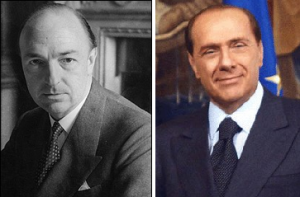
ROME—Silvio Berlusconi made unwelcome legal history in Milan on Wednesday when he became the first serving Italian Prime Minister to go on trial for paying for sex with an under-age prostitute and abuse of office.
In a land where it is not unusual for senior politicians to find themselves accused of serious crimes, Mr Berlusconi’s mounting legal woes are turning into the Italian equivalent of Britain’s Profumo affair of the 1960s. This was a liaison between the Secretary State for War, John Profumo, and the bubbly call girl Christine Keeler, whom the minister first encountered as she emerged naked from Lord Astor’s swimming pool.
There are remarkable similarities between the two sex scandals and an important difference: the reaction of society.
The British political establishment was especially outraged when it emerged that Mr Profumo had lied about the affair to Parliament, behaviour that was seen as beyond the pale and contributed to the fall of the Macmillan Government.
The sexually tolerant public opinion of 21st century Italy has reacted with astonishing equanimity to lurid accounts of the 74-year-old Prime Minister’s “bunga bunga” sessions with a harem of nubile young women, including, it is alleged, the then 17-year-old Ruby Heart Stealer.
Bunga bunga has entered the Italian language – and English too, for that matter – but many Italians have taken the view that what Mr Berlusconi got up to in the privacy of his own palatial home had no bearing on his ability to lead the country.
Ruby, the Moroccan belly dancer Karima El Mahroug, has been seen as an unlikely victim of the Premier’s libidinous attentions.
A thief, a prostitute and appearing more physically mature than her controversial real age, Ruby’s grasping and cynical conduct seemed to some to convert the septuagenarian lothario into the real victim of the affair.
Like Christine Keeler, Ruby appears to have been extraordinarily indiscreet, blabbing to friends and acquaintances – even to the police officer who arrested her for theft – about her connection to the Prime Minister.
According to prosecutors, it was concern over the girl’s notoriously loose tongue that prompted Mr Berlusconi to abuse his office by calling Milan police headquarters to solicit her release, evoking a non-existent relationship to President Mubarak of Egypt and a potential international incident.
The Profumo affair was given an added gravity by Ms Keeler’s relationship with Captain Yevgeny Ivanov, the Russian naval attaché, which immediately raised issues of national security.
Similar fears over the security consequences of indiscreet pillow talk have emerged in the Ruby affair, as investigators uncovered the alleged organized crime links of some of the hard-bitten young women who allegedly attended sex parties at the Prime Minister’s Arcore mansion.
There have even been unsubstantiated allegations of intelligence service interest in the procurement of the Prime Minister’s escorts. The personal weaknesses of a head of Government would inevitably be of professional concern to secret services, from both friendly and hostile nations.
Milan investigators have devoted particular attention to the role of Dario “Lele” Mora, a talent scout suspected of links to the Calabrian Mafia who is accused, with others, in a separate case of procuring prostitutes for the Prime Minister.
Mora’s alleged role seems to resemble that of Stephen Ward, the society osteopath who befriended Ms Keeler and who committed suicide before the end of his trial for living off immoral earnings.
Mr Berlusconi’s lawyers have called numerous witnesses to testify that Ruby is a fantasist and that the Arcore soirees she and others have described were elegant affairs where political conversation was lubricated with nothing stronger than Coca-Cola.
Critics of the Prime Minister, in contrast, say the Arcore parties have corrupted Italian democracy.
They were used not only to gratify the Premier’s sexual urges, the critics say, but to recruit the female component of Mr Berlusconi’s political party, and they point to British-Italian dental hygienist Nicole Minetti as a prime example of a political career launched from Arcore’s underground discotheque.
The opposition also complains that Italian institutions have been further frayed by the laws passed in Parliament to stave off Mr Berlusconi’s trials.
Last week anger boiled over in the Chamber of Deputies and among demonstrators outside when the Government majority attempted to ram through a new law that would further reduce the period of time after which white-collar crimes – such as bribing a lawyer to provide false testimony – would be timed out under the statute of limitations.
One of the trials most exercising Mr Berlusconi at the moment is that for bribing London lawyer David Mills, which is about to resume in Milan.
In riotous scenes the Defence Minister invited the Speaker to “fuck off”, the Justice Minister threw his parliamentarian’s badge at the opposition benches, and someone threw a newspaper at the Speaker.
It all amounts to an alarming degree of political tension and institutional stress in a country engaged in a war in Libya and struggling to respond to a humanitarian crisis precipitated by a massive influx of refugees from NorthAfrica.
Like Mr Berlusconi, John Profumo was rich and of Italian ancestry. He found redemption, following his fall from grace, by working tirelessly for the poor and disadvantaged in London’s East End.
A growing number of Italians now hope Mr Berlusconi might follow his example, however the trial that began on Wednesday might end.
With the wealth at his disposal Mr Berlusconi could certainly do a lot of good.