

Crossroads of the World: Venice and the Lod Mosaic
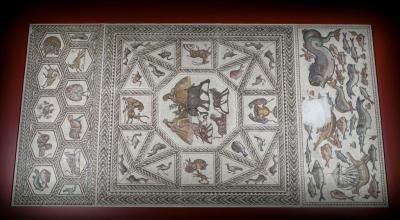
VENICE - As a residential fellow at the Fondazione Giorgio Cini in Venice, I was invited to the press opening of “The Menagerie of Wonders,” the Foundation’s temporary exhibition of the Roman mosaic of Lod, which opened to the public on Friday.
The exquisite mosaic, discovered in 1996 during work on the expansion of a highway in the Israeli town of Lod, is remarkably intact and exceptionally conserved. With its exquisite detail and its poignantly rendered depiction of the wonders of the natural world--sea creatures, birds, tigers, gazelles, a giraffe, and elephant, and a rhinoceros—the mosaic speaks from the past with serenity and symmetry about the marvelous plentitude of nature. It dates back to before the end of the fourth century, when the city was inhabited by Romans, Christians, and Jews.
I am not an art historian, nor an archaeologist. I am literary scholar in Venice to do research for a book on American expatriates in Italy and postwar glamour, but this mosaic, an ancient poem fractured and reassembled in stone, spoke to me with a sense of urgency.
Most probably because it is was discovered in the troubled city of Lod, Israel, a place plagued with problems, nearly all stemming from Arab-Jewish conflict, a place where neighborhoods are fenced off, Arab houses are razed, and city services seem to work for no one. The ancient city sat at the intersection of Cairo-Damascus and Jaffe-Jerusalem roads, probably never a peaceful place, but one where diverse peoples prospered and learned over the centuries to trade and talk, to live and worship next to each other. Their secrets to living among diversity seem buried deep in that troubled soil, something to which this mosaic attests.
Listening to a description of the international collaborative effort to preserve this treasure, my thoughts turned to what had transpired in Palmyra, Syria in the past week. ISIS had blown up the 2000-year old Arch of Triumph that stood at the entrance to the grand colonnade that led to the great temple of Bel.
Palmyra, referred to as the 'Venice of the Sands,' was not only one of the world’s most beautiful and best preserved archaeological sites, it was a testament to the prosperity that grows from the integration of diverse culture influences, economic savvy, and civic dedication to embodying cultural values in ways that will outlast current generations. Not unlike Renaissance Venice.
As I walk through this city’s tangled streets, wander into its dark churches, and gaze back toward San Marco from the vaporetto as it heads toward the island of San Giorgio Maggiore, I wonder about its future, how long it will stand as a monument dedicated to humanist values, republican ideals, and inconvenient beauty. Last week The Guardian named Venice one of the world’s ten most vulnerable cities. At risk from a rising sea levels and compacting subsoil, Piazza San Marco is flooded 100 days a year.
Though there are still quiet spots in Venice, when the cruise ships dock the city is flooded in a different way. Depending solely on tourism can mean death to a culture, and Venice is also vulnerable in this way. What will remain of it 2000 years from now?
Venice, Palymra, the Roman Mosaic of Lod, all seem to converge in some way to show what is at stake when we lose important cultural artifacts from the past---and what we gain when we preserve them. The physical embodiment of cultural values is important. They give shape to our beliefs and connect us others who experience them. They speak to common human experiences and the human achievements that will transcend our own short lives. When we lose them through ignorance, barbarity, or avarice, we lose part of ourselves. When we preserve them, they are a reminder of and a challenge to our better natures.
Included in the exhibition is a piece from the preparatory layer of the mosaic, containing a footprint and a sandalprint left by the workers as a ghostly reminder of the effort and dedication required to create and sustain beauty.
It is a deeply touching human detail that adds to the mystery of the lack of human figures in the mosaic itself. This is only one of its mysteries. There is a suggestion of an invisible human presence, but the hunting scenes occur in nature and contrast with the centerpiece in which various animals peacefully coexist with each other, watched over from a mountaintop by a lion and a tiger. Is it a metaphor for the peace and prosperity of empire? Is it a subtle Christian rejection of those values and the promise of paradise where the lion will lay down with the lamb? Is it merely the home of a rich businessman, whose trade was in exotic animals destined for gladiatorial spectacle? It could be all and none of these.
Each place the mosaic has been shown has given it a different name. Here in Venice it is “A Menagerie of Wonders.” In St. Petersburg it was “Unfading Colours.” At the Penn Museum it was “Unearthing A Masterpiece.” In Chicago it was “Natural Wonders.”
All are true, and yet none of them come close to piercing its mystery. It remains resolutely beautiful and silent, writing in stone the mystery of human experience--harmonious, contradictory, violent, puzzling, and beautiful.
Venice, strangely, is the perfect temporary home for this haunting and sumptuous piece of our collective past.
Lisa Colletta is Professor of English and Director of the Communications and English Program at the American University of Rome. Her research interests include the twentieth-century novel, humor studies, travel literature, and literary history, especially as it relates to ideas of modernity, narrative, and aesthetic response. Her work has appeared in numerous journals and essay collections, and she is the author of British Novelists in Hollywood: Travelers, Exiles, and Expats (2013), Dark Humor and Social Satire in the Modern British Novel (2003), and the editor of Kathleen and Christopher: Christopher Isherwood's Letters to his Mother (2005), and co-editor with Maureen O’Connor of Wild Colonial Girl: Essays on Edna O'Brien (2006). Her latest book, The Legacy of the Grand Tour: New Essays in Travel, Literature, and Culture, will be out in December 2015.
Il Serraglio delle Meraviglie: Il Mosaico Romano di Lod alla Fondazione Giorgio Cini
09/10/2015 – 10/01/2016
Sale Del Convitto
Isola di San Giorgio Maggiore
Venezia