A triangle of deceit — Harold Pinter’s Betrayal
Philippa Malicka
|
29 March 2011
Directed by Donnacadh O’Briain - Produced by The Independent English Theatre of Rome
ROME– The plot of Harold Pinter’s Betrayal is fairly simple and the chances are you will have heard something like it a hundred times before. Robert (Gianpiero Cognoli) and Jerry (Rinaldo Rocco) are best friends, they both work in the publishing industry and each is married. Robert is married to a woman called Emma (Sandra Paternostro) with whom Jerry enjoys a long affair, which ends at the beginning of the play. This is the first betrayal.
The second betrayal lies in the fact that Robert knows about the affair, having known about it for four years since Emma confessed it to him, in effect betraying Jerry. Despite being knowingly cuckolded, Robert continues his friendship with Jerry and never lets on that he knew. The play charts the entangling of a labyrinth of deceit, moving backwards from two years after the end of their affair to the moment when Jerry and Emma first kiss.
This challenging structure meant that the actors had to become more naive and hopeful as the play progresses. The lovers had to work backwards through the affair, peeling off the layers of deceit and betrayal like an onion to the first passionate encounter. The result of this reverse chronology is striking, forcing us to examine the sordid seven year outcome of a moment’s surrender.
A plot this deceitful can sometimes seem improbable, at least we would wish it were. But in fact Betrayal was inspired by real events in Pinter’s life. Whilst still married to his first wife Vivien Merchant, Pinter embarked on a seven year affair with English television presenter, “the thinking man’s crumpet” Joan Bakewell. Details from her personal biography confirm the similarities between the life and the play text, the flat that Bakewell kept with Pinter echoes that owned by Jerry and Emma. Bakewell and Pinter’s affair was rumbled by a classic mix-up of letters, this too is how Robert finds out he has been betrayed. As reductive as it is to value a work for its autobiographical content, this similitude explains in part Pinter’s poignant insight to the classic love triangle.
Throughout this production, it was Rinaldo Rocco who delivered a consistently brilliant performance as Jerry, exploring both his charming veneer and deep uneasiness with deception and lies.
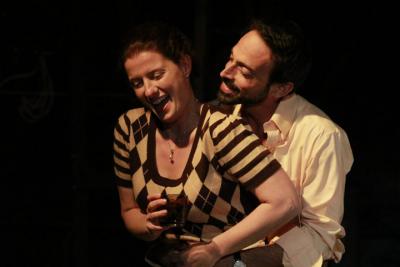
Rocco impressed because made he the best use of Pinter’s characteristic pauses. Pouring wine in the flat, the love nest that he shared with Emma he created a moment of poignant silence and internal reflection. Throughout the play we view Jerrty through his relationships, the Jerry with Emma or the Jerry with Robert. In many ways ‘Betrayal’ is a study of the multifaceted nature of human life, and how we, whether consciously or not, shape those with whom we interact. But in this moment he suddenly became isolated from his mistress and the audience caught a rare glimpse of a persona undefined by others around him.
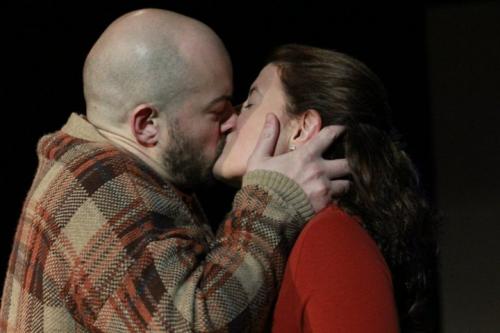
The final scene of ‘Betrayal’, which takes place in Robert and Emma’s bedroom makes for an unusual crescendo. Accosting Emma and kissing her, Rocco played a markedly different person from the wearied man, wiggling free of his stale affair that we encounter at the beginning of the play. Making brilliant use of the opportunities that the reverse chronology of the play presents, by the play’s ending, he was youthful, bounding around the stage in agitated lust.
The close and fragile relationship between Robert and Jerry is one of the most important intimacies of the play. Speaking about the affair Robert says “I hope she looked after you alright”, and Cognoli was excellent in suggesting Robert’s purely hetero admiration for Jerry, and the painful tinges when this feeling was unreciprocated and the friendship betrayed.
Both characters cleverly picked up on Pinter’s squash metaphor which runs through the play-one of the ways that the playwright uses a part of small talk to signify a grander narrative. When they meet, the men always toy with the idea of a squash match- but inevitably end on its improbability or impossibility. Neither really wants to play each other, just as neither really wants to challenge one another over the affairs. Again, Cognoli impressed here by demonstrating Robert’s perverse passivity to Jerry, showing he would much rather be Jerry’s equal than his superior.
Robert is a wounded yet remarkably stoic cuckold. While his emotions are coolly stifled, his suffering should be subtle and gradually discernible. In this production Cognoli frequently overplayed Robert’s inner torment and appeared too menacing. Yes, Robert is a bastard, he hits Emma (”to relieve an itch”, he boasts) and has affairs himself, but in this production he was too brooding.
The restaurant scene where Jerry and Robert lunch together is the closest Robert comes to an emotional outpour. But rather than a simmering sense of violence Cognoli overplayed Robert’s drunkenness- he was clownish rather than powerful with his knowledge of the affair and this pivotal, revelatory scene lacked the grievance and passion with which it was originally instilled.
Cognoli’s finest moment was in the Venice hotel room, where Robert confronts Emma about her affair. His explanation of how he came across a letter from Jerry was lengthy but controlled and he appeared fixated on his wife’s new strangeness. Unfortunately, Paternoster as Emma failed to reciprocate the tension in this charged scene. Pinter’s females are known to be mysterious and aloof, but with Robert, Paternoster was too vacant. Her revelation “we’re lovers” was not at all confessional and felt rather flat and unrealistic.
Of course, Emma was much more animated in the scenes with Jerry, and here Paternoster showed herself to be capable of a magnetic sexual energy. Oscillating between girlish flirtation and adulterous anxiety, Paternoster deftly showed how Emma is perhaps the loneliest side of the triangle, the foundation of which being friendship between Robert and Jerry in which she can never participate.
A bed remained in the middle of the stage throughout the play-an impressive aspect of design (Alessandro Bentivegna) , which placed sex at the center of the labyrinth of relationships. This was particularly effective during the scenes which took place in Emma and Jerry’s flat: it demanded the audience to ask whether there can ever be a secure location for an affair? Many of the arguments between the adulterous pair were based around the flat, whether it was “a home” or “a flat for fucking” as Emma bitterly puts it. Throughout, the flat is the symbol of all of the inexorable vicissitudes which plague any drawn out extra- marital relationship. The brilliant early break-up scene between Jerry and Emma capitalised on this- the bed, the table cloth, the keys to the flat- all of these were shown to be sordid accessories to the infidelity.
Pinter’s play presents us with a series of betrayals, but what resonates most is the human capacity to betray the self. Self-deception is the theme which emerges from the whole mess. In this sensitive production O’ Briain carefully examined each corner of the love triangle, eventually suggesting how betrayal not only ruptures relationships but also, perversely, binds them.