

The Tuscan town that awes Americans
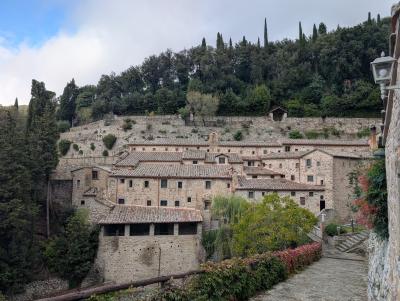
CORTONA- During the 800th anniversary of Saint Francis’s death--which has been proclaimed a special Franciscan Jubilee Year by Pope Leo XIV-- this notable Franciscan town offers far more than its impressive churches, museums, restaurants, and its fourth-century BC Etruscan wall.
Cortona is located in the province of Arezzo, whose capital city is just a 40-minute drive away. It is also just over two hours from Rome by train or car which makes it a great first stop in Tuscany.
Made more popular by Frances Mayes’ book and later film, Under the Tuscan Sun, Cortona is the perfect hill town to begin your Tuscan adventure.
In her book about moving to a Tuscan town to fix up a villa, Mayes wrote, “I had the urge to examine my life in another culture and beyond what I knew.” Lines like these have drawn several Americans and other expats to follow her path in the Tuscan town.
Some of the American visitors have purchased second homes in the centre and the surrounding countryside which has helped the city’s economy. Some local residents have noticed the increase in housing prices as a result.
Another key American tie to the city is the University of Georgia’s Cortona Program, the University’s oldest study abroad program established in 1970. They offer 14-week programs based in their 15th-century villa for Fall, Spring, and Summer.
Our first stop for a lunch in the garden was at the Minimarket Lunghini run by Claudia and Daniela Lunghini since the 1980s. However, the family store’s original location, down the road, Locanda del Ponte (Inn by the Bridge) dates back to 1857 and holds the seventh commercial license issued by the commune of Cortona.
Today, the small grocery store is a popular place for lunch on the weekend when the lines extend into the parking lot. They also offer a tavola calda plus all of the regional meat and cheese options.
A great stay option during a visit is the 15th-Century Locanda al Pozzo Antico located inside the city centre wall and steps away from the main sights. The owner, Paola, welcomed us and shared the story of the historic renovations that she and her husband, Franco, completed over the years after they purchased it in 1996.
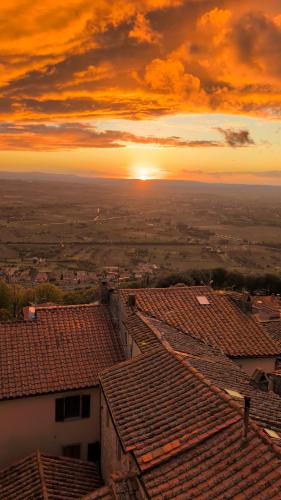
The six-room bed and breakfast has a small restaurant, Al Pozzo Antico, where Paola offers afternoon cooking classes to visitors. One of the rooms has its own tower with a balcony on top which overlooks the town and the valley below. The perfect place for a sunset.
The city has an impressive selection of restaurants. Taverna Pane e Vino was our first choice and did not disappoint. The large menu was brought to our table and was filled with regional and seasonal options. Some impressive starters were the bruschetta with exceptionally new olive oil, mortadella wrapped around breadsticks, and prosciutto and salami served with soft regional cheese.
The standout dishes were the cannelloni with a sausage ragu, Tuscan kale, and a Taleggio fondue and the raw Chianina beef served with olive oil, capers and olives. A nice way to conclude the meal was the Tuscan almond cookies with sweet wine and homemade chocolate pie.
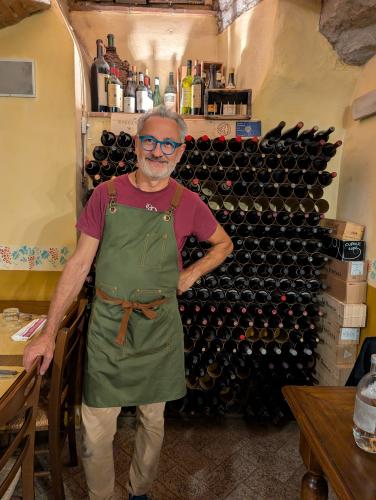
The owner, Arnaldo Rossi, suggested a number of wines for the evening. As a local producer, he was definitely in his comfort zone. With his focus on ancient trends and biodiversity, Rossi could be considered a wine “hipster.” His vineyard is a 20-minute drive from the centre where he focuses on the Sangiovese grape. There, he restored a 100-year-old vineyard where he practices an ancient Etruscan technique of growing the vine with the support of trees.
“They married the vines together with the maple tree,” said Rossi, as he gave us a tour of his vineyard the following day. When he restored the vineyard in 2014, he had to replant some of the trees and vines at the same time.
The Museum of Etruscan Academy and the city of Cortona, or MAEC, is located in the historic Palazzo Casali. To understand the city’s deep ties to its ancient past, a visit to the museum is essential. The building displays the Tabula Cortonensis, known as the Cortona Tablet, which shows a 200-word inscription of the Etruscan language, the longest that has been found in the 20th- century.
Another highlight is the Etruscan Lamp of Cortona discovered in 1840 which is impressive with its mythological motifs and is a great example of Etruscan bronze work.
The museum also houses temporary shows. We had a chance to see the works of Gino Severini, a leading Italian Futurist from the early 20th-century. The Cortona native divided his time between Paris and Rome, ending his career back home in Cortona.
The Eremo delle Celle (Hermitage of Le Celle) is a historic Franciscan monastery a few kilometers outside of Cortona. It’s located in a wooded ravine at the base of Mount Sant Egidio divided by a stream. It was founded by Saint Francis in 1211 with the help of Guido Vagnottelli who gifted the land. Known as Blessed Guido of Cortona, he was a wealthy nobleman who gave up his possessions after becoming a companion of Saint Francis.
The monastery blends with nature and provides a peaceful retreat to its visitor. We were immediately met by a friendly cat who, in the spirit of Saint Francis who was the patron saint of animals, followed us around for the remainder of our tour. Francis returned to Le Celle during the year of his death in 1226 on his way back to Assisi.
Just up the hill from Cortona is the Basilica of Santa Margherita, named for the city’s patron saint. Margaret of Cortona (1247-97) is the patroness saint of single mothers. She ran away from home at the age of 17 after being seduced by a young knight. She was not welcomed home after returning unmarried with a son after his father, the knight, was killed. She found refuge with the Franciscan friars of Cortona.
There, she dedicated her life to serving the needs of the poor, heavily influenced by the life of Saint Francis. She established a hospital for the poor along with a congregation of Franciscan sisters to run it. In 1288, she lived in isolation near the ruins of a small Basilian chapel leading efforts to rebuild it. In 1330 the city rebuilt the church designed by Giovani Pisano in order to house her remains. She was later canonized by Pope Benedict XIII in 1728.
The Chiesa di San Francesco finished in 1246 in the centre of town is reportedly the second Franciscan church built after the first in Assisi. Its relics include tunic of Saint Francis along with his pillow and evangeliary. The church is the resting place for Frate Elia, a close companion of the Saint and the architect of the church. Luca Signorelli, a Renaissance master from Cortona, is also buried in the church.
The history, food, and culture made Cortona a delightful stay, but the true joy was discovering the stories from the people that live there. Every business owner that I had the pleasure of speaking with is deeply proud of their city, each contributing to making it a must-see destination on your next visit to Tuscany.
© COPYRIGHT ITALIAN INSIDER
UNAUTHORISED REPRODUCTION FORBIDDEN