

What London's Ukrainians told me about the future of their homeland
LONDON -- If you thought Italy’s demographic decline was bad, wait until you see Ukraine’s. With a fertility rate of just 0.9 children per woman, the granary of Europe is alarmingly close to South Korea’s notoriously low levels.
This, however, is not a recent trend. The Russian invasion and four year war of defence by Ukraine has accelerated a demographic decline that already was under way. For more than three decades, Ukraine's population has tumbled. Since gaining independence from the Soviet Union in 1991, the country’s population has fallen from around 51 million to an estimated 28 million in the areas currently under government control (excluding those under Russian occupation).
according to the Center for Economic Strategy’s fifth report, women under 35 and children make up the majority of the 5.6 million Ukrainians currently living abroad as refugees.
Despite foreign investment and worldwide support for Ukraine’s eventual victory over Putin, the millions of missing women and children will shape the country’s future, raising the question of who will be left to rebuild Ukraine and give it new life.
Ukraine, London-Style
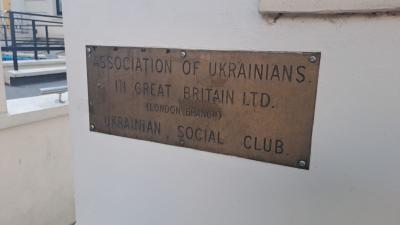
I went to London to look for an answer. Just a short walk from Holland Park station, near Notting Hill, a small golden plaque on a wall reads “Association of Ukrainians in Great Britain.” It is easy to miss.
As I stood there, trying to understand why that centre was there in the first place, a man stopped me and said “My wife is rehearsing with the choir. Would you like to come in?”
I stepped through a small doorway and entered what was almost another world -- Ukraine, London-style. Wooden walls, Ukrainian food on the counter and, beside it, a stack of Lvivske beers. From the hallway, the choir sang, “Як тебе не любити, Києве мій!” (“How can I not love you, my Kyiv!”).
Here, I met Svitlana, a volunteer, English teacher and member of the choir.
“This is one of the main places for Ukrainians in London. Many of us call it Domivka, home. The heart of Ukrainians is here.”
The Ukrainian presence in Britain is much older than the current war. The first major wave arrived after the Second World War, when political exiles fled Soviet rule. The community grew again after the collapse of the Soviet Union, when Ukrainians gained greater freedom to leave the country.
Sergei is one of them. After growing up between East Germany and Uzbekistan, he returned to Ukraine and joined the police.
But the post-Soviet system disappointed him. “In the police department, I realised I was working for three people: the government, my superior and those I owed favours to.”
In 1998, he left for Britain in search of a country “within reach of normal people”. Twenty-five years later, he is a bus driver in London. He has been married twice and has a son who was born and raised in the UK.
Then came the Russian invasion in 2022. The United Kingdom introduced special visa routes to help Ukrainians, including the Ukraine Family Scheme. Since the beginning of the full-scale invasion, around 234,000 people have arrived in the UK through the Ukraine schemes, although a significant number have since left the country, the Home Office says.
The scale of the movement was unprecedented in recent UK history, and London became one of its most visible destinations. Before the Russian invasion, around 19,000 Ukrainians lived in the capital. Within two years, the community had tripled in size.
The Ukrainian Cultural Centre suddenly found itself at the centre of this new migration. Its rehearsal room and cafeteria remained closed for months. The entire building became a warehouse for humanitarian aid.
“At first, it was mostly women with children,” Svitlana told me. “They arrived without the slightest idea of what to do next.”
Among them was Yuliia, a former neonatologist from Chernihiv. When Russia invaded, Yuliia left Ukraine with her five-year-old son through the sponsorship scheme.
“At the start, I thought we would stay for a year or so. In the end, it became three.”
She eventually moved out of her sponsors’ home and into a council flat. Today, she works as a GP's assistant and is slowly rebuilding her medical career.
“I will likely keep living here for many more years,” Yuliia told me.
The reason becomes clearer when I speak to her son, who tells me in a thick accent, “I feel British... From Ukraine, I only remember my grandparents’ house in the countryside and the farm animals.”
But the doors to the UK are gradually closing. The Ukraine Family Scheme closed in February 2024, and a new scheme was introduced in 2025, allowing Ukrainians already in the UK to extend their visas.
By no means everyone I met, however, had left Ukraine intending to build a new life abroad.
Some, like Ludmilla, thought her stay would last only a couple of months. She came to London in 2023 to help a friend organise a charity event in memory of his mother, who had tragically died in a bomb attack in Kyiv. Ludmilla regularly sings in the choir at her local Orthodox church. By chance, she was introduced to Sergei, a bus driver by day and a musician by night.
“The moment I shook his hand and looked into his eyes, I knew he was the love of my life.”
Two months later, they got married. Today, they are business owners, running their own music school in London.
Beautiful as their story is, Ludmilla’s daughter is still in Kyiv. Despite having a sponsorship visa that would allow her to join her mother in Britain, she has chosen to stay. Her boyfriend is fighting at the front.
Had it not been for Sergei, Ludmilla would have returned to Kyiv and to her work as a music teacher.
Like all the Ukrainians I spoke to, she remains in constant touch with the news from home. “Every time I read about a missile over Kyiv, I call her immediately and pray to God to save her.”
A refugee’s life is nearly always split between two realities. Even in a safe country of refuge like the UK, the people left behind in Ukraine remain at risk. Ludmilla’s heart trembles every time she hears a Telegram notification, while Yuliia fears for her parents' lives in Chernihiv.
Over the past four years, Ukrainian refugees have made impressive strides towards integration. Thanks to the UK’s dedicated refugee schemes, children have grown up speaking English, while mothers have found stable employment and homes. Little by little, a new normal has emerged, bringing with it a new way of planning for the future; not in months, but in years. This is confirmed by the Office for National Statistics which found that 68% of Ukrainians in the UK plan to stay long term.
Yet even integration is unable to boost Ukraine’s fertility rate. With so many men deployed at the front and families separated, having children is far from the minds even of those who now call the UK home.
According to the United Nations, Ukraine’s population could fall to 15.3 million by 2100—roughly half its current estimated size.
So, who will be left to rebuild Ukraine? The question remains open. It’s clearer than ever, however,that Ukraine will need support long after a peace treaty is signed.
F.P.
© COPYRIGHT ITALIAN INSIDER
UNAUTHORISED REPRODUCTION FORBIDDEN