

Student protests rock Italian major cities but stop short of French frenzy
ROME – Following a militarily controlled chaos across Italian cities throughout the night before, on Sunday the sound of police helicopters was no longer heard over the eternal city.
Student protests on Saturday promised to bring the ‘French model’ of protesting to Italy, against high costs of living and studying in the country but when groups gathered in Piazza della Repubblica and the Imperial Forum at 2.30 p.m., they were pre-emptively met with the Italian armed forces. The aftermath of the protests in Milan and Bologna the weekend prior, which were blasted by politicians for devolving into looting and vandalism, the Italian government upped the ante and heavily prepared for Saturday’s demonstrations. Giorgia Meloni, the Italian Prime Minister, announced on Tuesday that “violent participation in protests” and covering one’s face during a protest would be considered a crime under new legislation.
The greatly anticipated protests went ahead in Rome and other major cities including but not limited to Florence, Turin, Milan and Bologna and while they did not quite reach the levels of disruption brought by the French students and Gilets Jaunes the past week, had their moments of what appeared to be a heavily controlled chaos.
Rome:
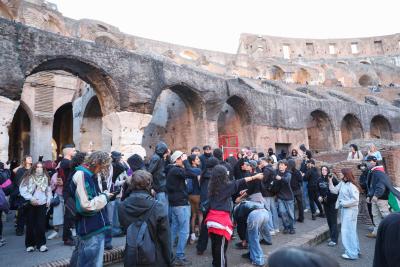
In Rome groups gathered in the main piazzas, where they were met with armoured vehicles, army and police officials waiting the Imperial Forum and Colosseum archeological park. Irrespective of this, around 6 p.m. protestors by passed security, entering and occupying the Colosseum. As of Sunday, there has been no reported damage to the Flavian Amphitheatre, which has stood for nearly 2000 years in the heart of Rome.
Throughout the day protestors peacefully made their way through the streets but by evening tensions had risen and according to Italian media and police officials, after glass bottles and fireworks were used against the police, water cannons were deployed in the centre of Rome, with videos flooding social media of their use against protestors and in other police armed with shields and batons were seen going against some crowds of protestors.
Police used the main train station Termini as a base to regroup during the protests and so people, including tourists that ended up inside, ended up locked into the station, during the height of the protests. Metro stations were entirely closed in the centre between Termini and Barberini during the height of the conflict.
Police helicopters flew overhead most of the night and protests were spread across the city, reaching Testaccio, where protestors can be seen fleeing police in videos shared on social media with but were mainly concentrated in the centre. According to the Rai, as of Sunday nine people were arrested during the protests and around 5000 were identified as people of potential interest.
Milan:
In Milano Today, it was reported that around 10,000 attended the protests, three individuals were arrested and 2,885 people were identified by police. Police had controversially charged Youssef Siher, the 30-year-old doctor of research, earlier in the day with the new crime of “organized violence during protest” and accused him of being the “mastermind” behind Milan’s October 17th protests. According to Milano Today, two Moroccan nationals were arrested for allegedly stabbing two other Moroccan nationals in a citizens’ social centre, which was linked to the protests, it is as of yet unclear why.
Following last week’s violence shops had already been boarded up and the protests were reported to be peaceful, with some papers like Il Giorno, reporting that there was a notable lack of hooligans this time.
Turin:
In Turin photos of the Prime Minister were burned and protests turned more violent. According to il Corriere Torino, there was panic in Piazza Crispi as protestors were closed in by police blockades and water cannons were deployed in Corso Principe. In Corso Giulio Cesare, after what were reported to be cobblestones lifted from the streets and a glass bottles thrown at police, tear gas was deployed. Only one individual was arrested during the skirmishes and 421 were identified by the police.
Bologna:
In Bologna, the famous Italian student city protests were much more chaotic. Water cannons and tear gas were deployed against protestors, with Bologna Today reporting that there were at least 17 injured individuals, including members of the forces of order.
Cobblestones were launched, shop fronts smashed-in and clients were barricaded inside shops in Via Riva di Reno throughout the chaos. Many, however, were reported to be peacefully protesting, sitting down in via Riva di Reno, with their hands up as chaos ensued all around.
og
© COPYRIGHT ITALIAN INSIDER
UNAUTHORISED REPRODUCTION FORBIDDEN