

Pope Leo has 'peaceful' night after cancer surgery but long-term prognosis unclear
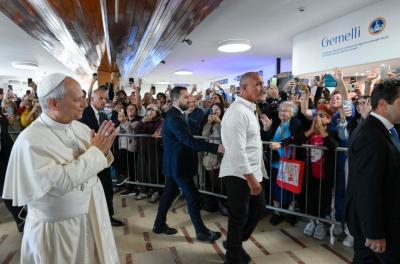
ROME – Pope Leo XIV passed a peaceful night Wednesday at the Gemelli Hospital after undergoing radical surgery for lung cancer, the Vatican said. Doctors who operated on the American pontiff said they removed the “the lower lobe of the right lung,” adding that the surgery was successful and there were no complications.
Leo, 71, now will undergo a period of convalescence and physiotherapy as well as further tests to determine whether the surgery has prevented the cancer spreading, Vatican sources said.
A carefully worded statement signed by the surgeon who led the operation, Professor Stefano Margaritora, and the pope’s personal physician, Dr. Luigi Carbone, was issued by the Vatican press office late on Tuesday evening.
The pope was in the operating room for three hours for the scheduled thoracic surgery, though the operation itself lasted about 90 minutes.
“To ensure a radical intervention, the lower lobe of the right lung was removed using a video-assisted technique,” the statement said.
The doctors said “the intraoperative histological examination confirmed the diagnosis of lung adenocarcinoma, as suspected by the preoperative tests,” referring to the tests he underwent before the decision was made to do the surgery.
“After the surgery, the pope woke up as expected and, following a brief period of observation, returned to his room on the 10th floor,” the statement said.
The Vatican said doctors were not currently speaking of chemotherapy or other therapies pending the results of other tests. The Vatican press office noted the medical statement spoke of the “radical” removal of the lobe as an indication that doctors removed all suspect tissue in hopes of removing any lingering traces of the cancer.
“Adenocarcinoma is the most common [type of lung cancer], also with the most favorable prognosis,” Dr. Stephen Liu, a lung cancer expert at Georgetown University’s Lombardi Comprehensive Cancer Center in Washington, D.C., told The Associated Press. “While we know the diagnosis we now need to know the stage.”
“We now need to know how big it is, how many spots in the lung are involved. Is it just one nodule, or more than one, and the lymph nodes, are they cancerous?” Dr. Liu said. The Vatican indicated that further test results will be forthcoming, possibly as soon as Wednesday morning.
If the cancer has spread, more tests will be needed to determine what kind of therapy to pursue, he said. Options include chemotherapy, a combination of chemotherapy and immunotherapy or targeted therapy, which involves oral medications for specific cancers.
Doctor Annalisa Bilotta, who works at the Salvator Mundi International Hospital in Rome, said:“We understood from the beginning that it was a diagnosis that indicated a malignant tumor because of the speed with which the operation was prepared. It appears to have been clear [to his doctors] after the initial tests that it could be 90 percent cancerous, hence the decision to operate so quickly, and not delay. So they removed a malignant tumor.”
She said that “the intervention was not simple because of the particular location in the lung, and they had to remove the interior lobe of the lung.”
Asked whether Pope Leo could travel to Latin America as planned from Nov. 6-17, she said, “I suggest we have to wait several days or a week for [the answer] to this question, and see how his post-operation [recovery] proceeds, and how he is feeling and reacting.”
© COPYRIGHT ITALIAN INSIDER
UNAUTHORISED REPRODUCTION FORBIDDEN