

Odesa's maverick Italian editor vows crusade against cancel culture and bureaucracy will continue
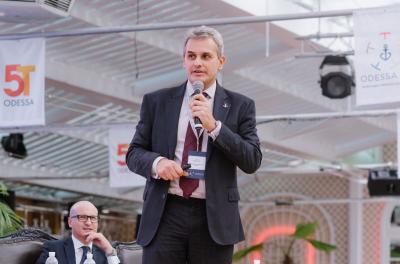
ODESA -- A journalist editing one of Ukraine’s campaigning English-language newspapers has come under pressure from both the country’s intelligence service and his Embassy in Kyiv after he co-founded an international campaign for tolerance and multi-cultural dialogue to prevail in this war-torn Black Sea port.
Ugo Poletti, an Italian from Milan, started the Odessa Journal in 2020 after moving to the port city in 2017 to work with a group of businessmen from italy starting a new hotel there. Russian attacks on the historic centre of the city have intensified in recent weeks, including daylight attacks by jet drones and missiles, whereas in the past bombing generally only happened at night, he says as we enjoy an espresso between air raid alerts in the shadow of the dazzling Opera complex. He has no intention of leaving, however.
During his years as effectively an ambassador for the small Italian expatriate community in the city, Poletti’s admiration for the way Ukrainians have held the moral high ground since the Russian invasion has grown. But he also has courageously spoken out against Ukrainian nationalists’ controversial brand of cancel culture that has led to a constellation of bans on Russian culture including performing classical ballets such as Swan Lake and the Nutcracker Suite by Tchaikovsky at the splendid Odesa opera house. The result has been that a number of promising young Ukrainian dancers have remained in the West at the end of foreign tours, fearing they cannot make an international career at home without such classics in their repertoire.
«Ukrainians are morally superior in many ways, for instance in their humane treatment of Russian prisoners of war,» he says. «Prisoners can be visited by the Red Cross, which is not possible with Ukrainian prisoners held by the Russians.»
Poletti also deeply admires the dynamism of Ukrainian entrepreneurs and how the Russian invasion has spurred technological advances and a smart economy.
«Here every young person has the energy to make a success of his own small company There is excellent WiFi everywhere. If you call a taxi it arrives within seconds. And of course they are making weapons, including ballistic missiles.»
The wave of arrests of officials at high levels of government in recent months also is a positive sign as Ukraine prepares for eventual membership of the European Union, he adds. «Under the Soviet Union corruption was controlled. After independence there was an explosion of corruption. And there was no training required for diplomats or civil servants.
«Now they have realised that they can’t go forward with that level of corruption.»
Poletti acknowledges that cultural nationalism has many precedents in the West, for instance the way the British Royal family changed their surname from Saxe-Coburg to WIndsor during the First World War so as to obscure the King’s German origins.
Yet as an Italian he cant help noting that «when we were fighting the Austrians for our freedom, nobody thought to outlaw Mozart.»
As Poletti sees it, Ukraine’s law on decolonisation which has led to the removal or covering up of statues of Russians in Odesa presents a potential serious potential hurdle for Ukraine’s putative membership of the EU. In Odesa it is estimated that as many as 90 percent of the population speak Russian at home, according to recent polls, while 20 percent are ethnic Russians. A significant percentage of the population are Russians with Russian passports who don't have Ukrainian nationality. Ukrainian authorities tolerate them though the strict curfew in the city is evidence of the military being on its guard against potential fifth columnists.
«In Lviv, for example, a 16-year-old boy was arrested for playing the guitar and singing a Russian song in public. Such measures ignore the fact that this is really at least a bilingual country. How can you tell a Russian speaker from Kharkiv who grew up in the Soviet Union whose son is fighting in the Ukrainian army that he's not allowed to speak Russian?»
«Most of the soldiers in the Ukrainian army are Russophone. But the heroes the government glorifies were allied with Hitler.»
«In Italy we also were friends with Hitler, and like here (during World War 2) that meant getting our hands dirty, for example by complicity in killing the Jews.»
«In western Ukraine people spoke Ukrainian for generations, but now anyone who doesn’t speak Ukrainian must be ‘fuori i coglioni,’» he says, using a popular Italian demotic idiom meaning «get out of our balls.»
«There was a cultural turning point. Now everything Russian is diabolocal and merda.»
Poletti and about 10 other Italians living in Odessa currently are the only visible survivors of a long Italian tradition in the city. «Italian merchants were dominant here until the Russian Revolution. Then most of the Italians escaped, but some of them stayed and slavified their names.»
Italy’s historic connections to Odesa led Rome to approve funds for the restoration of cultural monuments in the city, but the results so far have been disappointing, he adds. «Half a million euros was pledged for the restoration of the cathedral here after it was bombed. Sometimes, however, accepting funds needs approval by the Ukrainian parliament.»
«If any of it has been spent, it is between 11 and 15 percent.» Red tape on the Ukrainian side also can stifle efforts to help. For example the Rotary Club in Australia pledged funds for charity work by the Rotary Club in odessa but the funds never arrived because they were subject to endless fiscal inspections by Ukrainian tax officials. «They demanded an encyclopedia of documents.»
Funds that Cambridge University wanted to send to help also were stifled in the same way.
Italian multinational «Fincantieri has pledged 10 million euros for the defence of the port of Odesa but nothing has been done so far,» he adds.
The flip side has been an evident inability of local authorities to promote their unique cultural heritage internationally, starting with the dazzling Opera Theatre.
«This city is marvellous. The Opera Theatre is like having a Ferrari. Its the most beautiful of all the lyric theatres in Ukraine. But it has zero marketing and zero international relations.»
«Tourism promotion in the past focussed on the beaches and night clubs. Another problem is a refusal to plan long term. If you want to have a big festival you have to plan ahead. Here they invite people to an event just two weeks ahead.»
Ukraine’s powerful intelligence agencies also contain rogue elements who can scare off foreign investors by making demands for money, he adds.
After Poletti and a group of Ukrainian intellectuals wrote an open letter to UNESCO questioning the burgeoning cancel culture Poletti was summoned for interrogation by local spooks when his residence permit came up for renewal.
The Italian Embassy also took umbrage at the controversy that erupted around the petition, which was supported by leading British and other historians.
«They told me ‘you really caused a mess,’» he says, flashing a grin.
Despite such pressures Poletti is adamant he will not be silenced.
«Things have to be said as they are,» he says with a smile. «Here we have lost all sense of danger.»
Dr. Poletti's cultural association Ukrainian Cosmopolis is on www.cosmopolis.com.ua
© COPYRIGHT ITALIAN INSIDER
UNAUTHORISED REPRODUCTION FORBIDDEN