

Mattarella hosts Estonian president, voices hope Ukraine talks 'bring results'
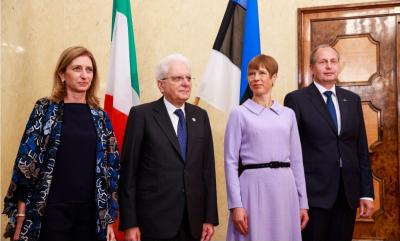
Rome — President Sergio Mattarella has said he hopes ongoing negotiations over Ukraine "bring results", speaking after a working breakfast at the Quirinale Palace with his Estonian counterpart, Alar Karis, on Monday.
The two heads of state covered a wide brief in their talks: European integration, common defence, the war in Gaza and relations with Israel, migration, and inevitably the war in Ukraine, now well into its fourth year. Italy's Vice Minister for Foreign Affairs, Edmondo Cirielli, also took part in the meeting.
Both presidents reaffirmed their support for Kyiv. Mattarella went further, expressing the hope that "the negotiations under way bring results" a carefully weighed formulation from a head of state who rarely strays from studied neutrality on live diplomatic processes.
The meeting fell at a delicate moment. Two days earlier, Ukrainian President Volodymyr Zelensky had met in Kyiv with US envoys Jared Kushner and Steve Witkoff, in talks initially billed as a possible breakthrough after months of deadlock. Any optimism, however, faded quickly once both sides issued guarded statements after the summit. Separately, the Élysée has indicated that American negotiators detected a "renewed willingness to negotiate" from Moscow, with Russia reportedly signalling it could return to the table once the Duma elections, scheduled for 18–20 September, are out of the way. European partners remain watchful rather than convinced.
The Quirinale meeting also took place hours after voters in Saxony-Anhalt, in the former East Germany, handed a landslide to the far-right Alternative für Deutschland (AfD), which took roughly 44% of the vote more than double its 2021 score and the party's best-ever result in a state election. The centre-right CDU collapsed to around 17–18%, a level unseen in the state's post-war history. The result AfD's strongest showing to date and a serious threat to unseat the centrist mainstream in a German Land for the first time since 1945 sent a chill through European chancelleries. Analysis of the vote suggested AfD had drawn particularly strong support among younger voters and blue-collar workers, as well as among those who previously abstained.
Sources at the Quirinale insist the German result was not formally discussed over breakfast: it is not Mattarella's practice, nor his custom, to comment on the outcome of free elections in friendly and allied states. Nothing has filtered out of the Colle on the subject. But it is hard to imagine that the vote's implications were entirely absent from the two presidents' minds as they turned, instead, to the need to preserve and press ahead with European integration, above all on common defence.
The choice of interlocutor was not incidental. Estonia shares some 300 kilometres of border with Russia, a frontier where drone incursions have become a near-daily occurrence; NATO fighters were scrambled again only a week ago after the latest one. For Tallinn, the prospect of the conflict spilling further west is treated as anything but a remote hypothesis.
For Mattarella, defending Kyiv is inseparable from defending Europe itself and, with it, a model of political and economic integration that, whatever its flaws, has underpinned eight decades of stability and growth on a continent once defined by centuries of war. Pressing further down that road, in his view, remains the only way out of the current impasse. It is precisely that goal which the rise of anti-EU forces on the far right in Germany and well beyond it now threatens to complicate.
PS
© COPYRIGHT ITALIAN INSIDER
UNAUTHORISED REPRODUCTION FORBIDDEN