

Middle East identities in transition discussed at EGIC conference

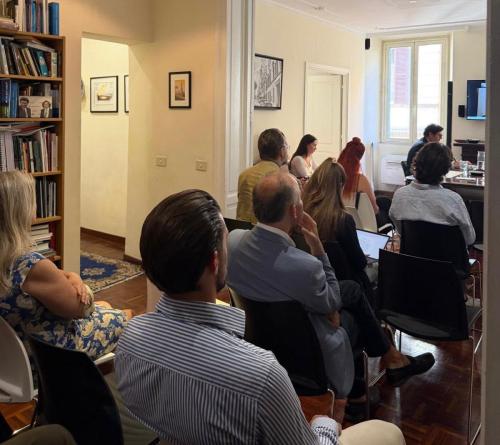
Rome — The evolving nature of identity across the Middle East took centre stage at a conference organised by the Euro-Gulf Information Centre (EGIC) on June 18, where academics and experts examined how social, political and religious changes are reshaping societies across the region.
Moderated by Mitchell Belfer, the discussion, titled “The Emerging Social Identity in a Changing Middle East,” explored how identities in the Arab world are being renegotiated amid economic transformation, technological change, conflict and shifting geopolitical realities.
The first speaker, Lebanese researcher Malak Darwish, argued that identity in the Middle East has never been static and is currently undergoing significant redefinition.
“Across the region, people are redefining who they are,” she said, stressing that identity should be understood as an evolving rather than fixed concept.
Darwish highlighted the profound transformations taking place in the Gulf, particularly in Saudi Arabia, where economic diversification, tourism initiatives and technological advancements are reshaping society. While maintaining strong links to tradition, Gulf societies are increasingly blending elements of the past with visions for the future, she noted.
Turning to the Levant, Darwish described identity as being under considerable pressure due to ongoing conflicts and rapid technological change. While digital connectivity has brought societies closer together, it has simultaneously created new forms of fragmentation.
Lebanon, she argued, represents a unique example of these broader regional trends. The country’s multilingual and multi-confessional character makes it difficult to define through a single identity.
“In Lebanon, people often switch between several languages within the same conversation,” she observed, arguing that such linguistic fluidity reflects the country's pluralistic identity.
Foreign influences from Saudi Arabia, Iran and Western countries, combined with repeated political and economic crises, have further complicated questions of identity in Lebanon. Nevertheless, Darwish maintained that younger generations, despite having grown up amid economic collapse and conflict, continue to shape a future-oriented national identity.
“Lebanon has survived because it continues to evolve, just like identity itself,” she said, adding that developments in Lebanon often foreshadow broader changes across the Middle East.
She concluded by questioning whether political systems in the region are capable of evolving at the same pace as their societies.
The second speaker, Emanuele Antonelli, focused on secularism and religious identity in Egypt, examining whether an inclusive Egyptian national identity can develop beyond strictly religious definitions.
Antonelli noted that, unlike in many Western societies where personal belief is considered a private matter and all citizens are subject to the same legal framework, religion continues to play a central role in Egyptian public life. Religious affiliation is recorded on identity cards and certain personal rights vary according to an individual's faith.
He cited concerns raised by Egyptian activist Patrick Zaki in 2019 regarding the application of Sharia principles in inheritance cases affecting Christian women, the treatment of Christian witnesses in some legal proceedings and broader issues of discrimination faced by Egypt's Christian minority.
Antonelli also referred to the work of legal scholar Huda Nasrallah, noting that Egyptian Christians are at times perceived as outsiders despite their longstanding presence in the country.
At the same time, he pointed to recent reforms introduced by Cairo, including a universal ban on female genital mutilation and legislation establishing 18 as the minimum age for marriage.
He further highlighted provisions contained in Egypt's new Family Law, introduced in May 2026, which established engagement contracts for Muslim couples and expanded shared child custody rights following divorce.
Antonelli also underscored the role played by Al-Azhar in promoting interreligious dialogue, referencing the institution's cooperation with Pope Francis on religious freedom initiatives.
He argued that Western governments should historically have devoted greater attention to religious rights and freedoms when engaging with countries such as Egypt.
The conference's third speaker, Francesco Celentano, broadened the discussion by examining competing international models regarding human rights.
Celentano emphasised that the Arab Charter on Human Rights represented a significant milestone as the first collective regional commitment by Arab states to human rights principles.
He contrasted this with the European Union, which places human rights at the centre of its political identity and institutional framework. China, he argued, tends to prioritise economic influence over human rights considerations, while the United States appears increasingly reluctant to intervene in international affairs.
These developments, he suggested, raise an important question for the future: which model will Middle Eastern societies ultimately choose to follow?
During the question-and-answer session, participants stressed that religion itself should not be viewed as a source of division, but rather as a potential foundation for common ground and regional identity.
Speakers also argued that social and cultural change should be regarded as a normal historical process rather than a cause for alarm, drawing comparisons with contemporary debates taking place in Europe.
The discussion highlighted the role of diaspora communities in shaping identities, with Lebanon and Brazil cited as examples of reciprocal cultural influence. Participants noted that the Lebanese diaspora has played a crucial role in preserving and transmitting Lebanese identity abroad while simultaneously enriching the societies in which it settled.
Finally, speakers pointed to institutional differences between Europe and the Arab world, noting that while Europe benefits from mechanisms such as the European Court of Human Rights, no equivalent judicial body currently exists to enforce the provisions of the Arab Charter on Human Rights.
PS
© COPYRIGHT ITALIAN INSIDER
UNAUTHORISED REPRODUCTION FORBIDDEN