

Art Review: Detroit lends Impressionism to Rome

ROME-The Detroit Institute of Arts has lent 52 masterpieces including Van Gogh, Degas, and Renoir to the Ara Pacis Museum in Rome. The show, “Impression and Beyond. Masterpieces from the Detroit Institute of Arts,” focuses on Impressionism and the transition to modern art, also displaying works from, Matisse, Picaso, and others.
Salvador Salort-Pons, President and CEO of the Detroit Institute of Arts, said, “I am very excited about the City of Rome having the access to the these works of art and sharing the story of Detroit and how this city was able to collect so well and so early. At the same time the city was building the world’s automobile industry.” He reemphasized that Detroit “was putting the world on wheels while the museum was collecting things that required vision and innovation because these works were not collected by other museums in America at the time.”
The works are part of a collection of European masterpieces created between 1840 and the early 1900s. The fact that some of these works were obtained by the Detroit museum so soon after its creation demonstrates the wealth of the city at the time.
Impressionism was a 19th century art movement which began in Paris and emphasized the transient effects of light and visible brush strokes. Artists often focused on painting outdoors rather than inside a studio.
This exhibition captures the transition in the history of modern art from the start of the Impressionist revolution in France to the avant-garde movement in the early 20th century. They highlight the start and evolution of modern painting, the exchange between light and color, industrialization and countryside, realism and abstraction which is the transition that redefined art over 100 years ago.
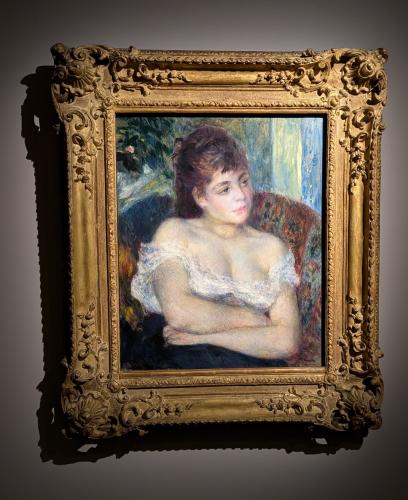
Some of the highlighted masterpieces include “Woman in an Armchair” 1874 by Pierre-Auguste Renoir. The painting has the quality of a sketch with its rapid brushstrokes and use of light on the face, torso, and arms. The identity of the woman is anonymous.
“Bank of the Oise at Auvers” 1890 by Vincent Van Gogh is another highlight. One of the artist’s final works before his death, the quick brushstrokes give the painting a great deal of energy. The use of light and the bright colors adds animation to the work.
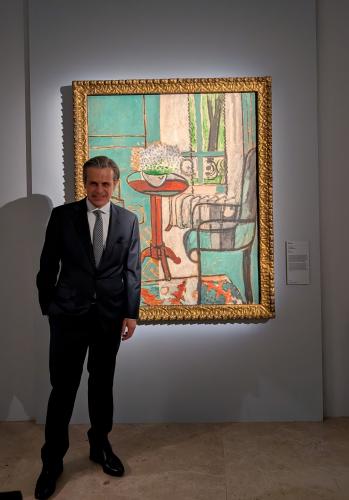
Another masterpiece, “The Window” 1916 by Henri Matisse, shows a threshold between the interior and the exterior which is a common theme in his work. You can still visit the hotel room in Morrocco where he painted “Window at Tangiers” four years earlier in 1912. “The Window” is accompanied by two other Matisse paintings, “Poppies” 1919 and “Coffee” 1916.
The show was curated by Ilaria Miarelli Mariani, Director of Civic Museums in Rome, and Claudio Zambianchi, Art Historian, University of Sapienza. The exhibition is sponsored by the City of Rome, Department of Culture, and the Capitoline Superintendence of Cultural Heritage.
The exhibition is located at Ara Pacis Museum, Lungotevere in Augusta from Dec. 4 to May 3 2026. Tickets can be bought online in advance or at the museum.
© COPYRIGHT ITALIAN INSIDER
UNAUTHORISED REPRODUCTION FORBIDDEN