

Two British lecturers seeking damages against Italy at European Court of Human Rights in wage discrimination case
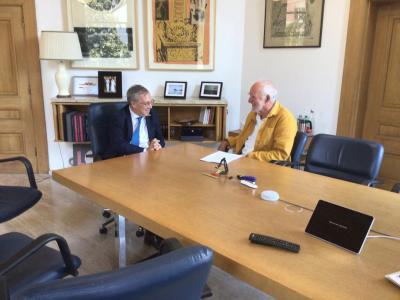
ROME -- Two British lecturers have lodged an application in the European Court of Human Rights in Strasbourg seeking damages of 352,450 euros against Italy for violations of a fair trial and a trial within reasonable time in a wage discrimination case, the Association of Foreign Lecturers in Italy (ALLSI) has said.
Lecturers Robert Coates, 62, from Fife and Dermot Costello, 74, from London were first employed by the University of Brescia in 1986 but have repeatedly been paid less than Italian colleagues carrying out similar teaching duties. The Britons are being represented by law professor Lorenzo Picotti of the Verona Bar, who has previously pled two lecturer cases successfully in the Court of Justice of the European Union (CJEU) in Luxembourg. Picotti emphasised the necessity of taking the case to the European Court of Human Rights.
“It is important and necessary to refer the matter to the European Court of Human Rights because national judges are not applying European Union law nor the judgments of the Court of Justice.”
Picotti’s point is underlined by the fact the European Commission has initiated a third liability case against Italy to deal with the ongoing discriminatory treatment of foreign mother-tongue lecturers in Italy. It will represent the seventh case since 1989 that the CJEU will adjudicate.
In 1996, Coates and Costello were granted open-ended contracts and equal pay with Italian colleagues in a legally binding ruling in the Labour Court of Brescia. This was upheld on appeal in 1998 and confirmed by the Italian Supreme Court of Cassation in 2001. However, the University of Brescia has continued to pay the British lecturers less than their Italian colleagues.
The Italian Law 63 of 2004 rules against wage discrimination based on nationality, with foreign teaching staff having the right to fair and equal pay and a single open-ended working relationship. In 2011, on grounds of this law, Coates and Costello were awarded damages for unpaid wages from the local magistrate of Brescia, 140,000 and 142,811 euros respectively. But these compensations were never paid.
The University of Brescia has refuted further compensation claims by the British lecturers, citing the 2011 Gelmini Law. Brought into effect by Mariastella Gelmini, Minister for Education, Universities, and Research in Silvio Berlusconi’s government, the Gelmini Law seeks to save the Italian state from paying millions in compensation to lecturers.
According to the Gelmini Law, Coates and Costello would be entitled to equal pay up to 1995, when they were considered teaching staff, but would not be entitled to equal pay thereafter when they were considered collaborators and linguistic technicians.
The case is further complicated by the interpretation of the working relationship between the British lecturers and the University of Brescia. The Italian Law 63 of 2004 rules on grounds of a single open-ended working relationship, but the University of Brescia argues the Britons were employed on two separate contracts – the first from 1986 to 1993 and the second from 1994 onwards.
In 2020, Coates and Costello asked the Brescia Court of Appeal to postpone proceedings and refer the case to the CJEU, pending a preliminary ruling on the Gelmini Law being implemented retroactively. The Brescia Court of Appeal refused this request.The same request was subsequently made to the Italian Court of Cassation in 2024 but was unlawfully refused.
The application lodged today in the European Court of Human Rights by the British lecturers is based on the Court of Cassation’s refusal to refer the case to the CJEU in 2024, the illegitimacy of the retroactive implementation of the Gelmini Law, and the unreasonable length of proceedings.
Coates and Costello currently seek damages for unpaid wages, 140,760 and 142,811 euros respectively, 14,400 euros each as compensation for the length of proceedings, 35,079 euros in legal costs, as well as the 5,000 euros they previously had to pay back.
David Petrie, chair of the ALLSI trade union supporting the application, criticised the treatment of foreign lecturers by Italian law.
“The Italian courts have been filibustering and cavilling, playing ping-pong with my colleagues for three decades, bouncing them back and forth into eight different courts. Successive Italian governments have shown a willingness to introduce retroactive legislation in order to influence the outcome of scores of legal cases that are pending.”
“Alarm bells should be ringing at the offices of the European Union: Italy, a founder member of the EU, is turning its back on a rules-based legal order that is essential to the functioning of the European Union.”
bq
© COPYRIGHT ITALIAN INSIDER
UNAUTHORISED REPRODUCTION FORBIDDEN