

Cuban opposition delegation lobbies Italy to end support for Havana government
ROME – A high-ranking delegation of Cuban opposition politicians visiting Europe is lobbying the EU and Britain to end development aid payments and financial support to Havana, arguing that Cuba’s socialist regime is “dangerous for the whole region” of Latin America as well as providing military support for Russia against Ukraine.
The delegation is headed by Orlando Gutierrez Boronat, Coordinator of the Assemblea de la Resistencia Cubana (ARC), who notes that as many as 5000 Cuban mercenaries have been recruited by Russia to fight with Russian forces against Ukraine in another sign of the Havana government’s potential for destabilisation. Dr Boronat presented his programme during a meeting with reporters at the Rome-based EGIC, the European Gulf Information Council.
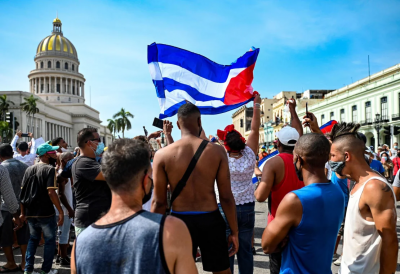
Cuba is the closest ever to a revolution overthrowing the Castro regime, Dr Boronat says, pointing to the uprising that erupted in 2021 with peaceful anti-government demonstrations around the island that were repressed by the police state with some demonstrators killed and others arrested and subsequently sentenced to prison terms ranging from 15 to 30 years.
“We have come to Europe to explain how the Cuban regime is dangerous for the whole region,” said Dr Boronat, whose father, an engineer, spent five years in work camps before the family went into exile.
Even before the 2021 rising there was resistance activity in Cuba that the world is largely unaware of, he added, for instance uprisings in 1980 and 1984.
In all as many as half a million Cuban dissidents have been sent to prison and an estimated 10,000 have died in protests, the ARC says.
The late Fidel Castro and his brother Raoul survived in power in part by never having elections and in part due to international support especially from the Soviet Union in the past and today due to financial support from Spain’s socialist party preventing the Cuban regime going bankrupt, Dr Boronat adds.
Inconsistent U.S. policy also has worked to the benefit of the regime’s longevity, he adds. “The resolution of the Cuban missile crisis involved Washington agreed to leave the regime in place.”
As well as Spain, Italy, France and the UK have invested in Cuba. Until 1959 the country fed itself and exported food but with the current parlous state of agriculture the island now experiences food shortages.
Dr Boronat also sees Pope Francis’s support for the island leadership as “misguided,” noting that in 2012 Catholic processions were banned in Cuba while last year the head of the Jesuit order on the island was expelled.
Much of the opposition to the regime has been nourished by members of Catholic religious orders on the island, such as the Sisters of Charity, he adds.
Western countries may have stopped short of supporting opposition groups for fear of a bloodbath by the 5000-10,000 ‘black beret’ counter insurgency troops on the island but sanctions could hurt support for the regime, particularly within the military. “If senior officers’ wives can’t go to Madrid to shop their husbands might withdraw support.”
Sine 1988 the EU has funded over 200 development projects in Cuba together worth some 300 million euros. Of those 80 projects for 155 million euros still are ongoing.
Against this background opposition leaders say they are confident that the clock is ticking for the end of the regime, given that Raul Castro, Fidel's brother, is now 92, while a majority of government figures are decidedly uncharismatic.
“The Cuban people want to be free,” Dr Boronat said.
jp
© COPYRIGHT ITALIAN INSIDER
UNAUTHORISED REPRODUCTION FORBIDDEN