

Italian engineer lifts international pesto prize
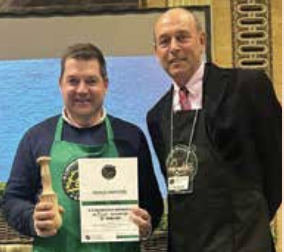
ROME -- A naval engineer from Liguria has emerged as the world champion of pesto making after 100 contestants gathered in Genoa to pound basil leaves into the popular green pasta sauce.
Mattia Bassi used his grandmother’s mortar and pestle to prepare his version of the traditional Ligurian sauce, which takes its name from the Italian word for pestle and generally requires garlic, pine nuts and olive oil to be completed.
“This was my first attempt. I did what I know how to do and evidently people liked it,” Bassi, 56, said, after claiming the winner’s prize: a wooden pestle with 2,000 euros worth of gold leaf wrapped around the handle.
Bassi said he had watched his grandmother, Rosetta, at work when he was a child and had been practising in the run-up to the competition, having tried to enrol unsuccessfully on a previous occasion. “I counted on getting to the final because I had been working hard on my technique, but I didn’t think I’d actually win,” he said, ascribing his victory to “passion and attention to detail.”
The father of three, who hails from Acquasanta, a village with 160 residents northwest of Genoa, shared one of the secrets of his approach: “Pound the garlic and pine nuts separately, because the basil leaves will not be well ground if they are mixed with the garlic and pine nuts. They have a cushioning effect, so the mechanical action of the pestle is less effective.”
The 100 finalists for the tenth World Pesto Championship faced off with their mortars and green aprons at long tables set up in a majestic hall of Genoa’s Ducal Palace, decorated with frescoes by Domenico Tintoretto and Veronese.
The contestants were drawn from a dozen countries around the world, with the oldest, Maria Carbone, aged 90, from Genoa, and the youngest, Nicolò Di Girolamo, a 23-year-old rapper from Rome. A Japanese chef, a woman from Paris and an Italian emigrant from Dublin were among those to reach the final 10.
Their efforts were judged by 30 experts, including chefs, researchers, journalists and food bloggers. Competitors had 40 minutes to come up with the perfect sauce.
“This year the level was extremely high,” said Roberto Panizza, the Genoa chef who founded the competition. “I’ve rarely seen a ranking where the difference in quality was so narrow.”
The magazine La Cucina Italiana, which provided one of the judges, had no doubt about Bassi’s merits. “We judged his pesto to be absolutely the best for manuality, colour, finesse, consistency and balance between ingredients among the 10 who reached the final, all of whom were very good,” it reported.
Pesto’s origins are relatively modern, with the first recipe appearing in a Genoese cookbook by Emanuele Rossi in 1852. An alternative version appeared 11 years later in a book by Giovanni Battista Ratto.
It allows marjoram and parsley as al- alternatives to basil and even admits Dutch cheeses, instead of grated parmesan, reflecting Genoa’s traditional trade links with northern Europe. However, experts have traced its lineage back to “agliata”, a sauce made of crushed garlic, olive oil, vinegar and salt, that has been consumed by the poor since medieval times.
ROBERTO PANIZZA’S PESTO GENOVESE SERVES: About 1 cup of pesto TIME: 30 minutes
· Basil leaves, washed and pat dried, 65g / 2.2 oz
· Italian Pine Nuts, 30g / 1 oz
· Vacche Rosse Cheese, 40g / 1.4 oz, grated or in chunks
· Pecorino Sardo, 20g / 0.7oz, grated or in chunks
· Garlic, 1 clove
· Coarse Sea Salt, 1/2 teaspoon
· Extra Virgin Olive Oil, 5 tablespoons
Preparation
Place the garlic in the mortar and mash it to a creamy consistency.
Add the pine nuts and crush them until you reach a paste. Add basil leaves and sea salt, without completely filling the mortar.
Press the basil leaves moving the pestle up and down. Once they are coarsely mashed, start moving the pestle in circles around the mortar sides. When you reach a creamy and uniform texture, add both types of cheese.
Pour the olive oil slowly, mixing it with a spoon to blend all the ingredients together and create an emulsified sauce. Give a final mix with the pestle. The process should take the shortest time possible, to avoid oxidation.
© COPYRIGHT ITALIAN INSIDER
UNAUTHORISED REPRODUCTION FORBIDDEN