

Historic Palermo street flaunts Art Nouveau urban installation
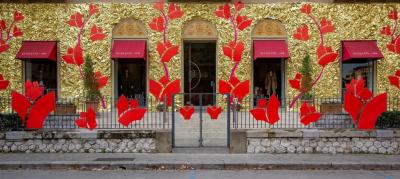
PALERMO – A large-scale, shimmering gold artwork named ‘Rebirth’ has been installed on the façade of the Giglio boutique in Sicily’s capital, in celebration of the city’s Art Nouveau history.
The building is situated on one of the city’s most iconic streets, via della Libertà, an archetypical example of the area’s sumptuous architecture.
The installation, called ‘Rinascita’ in Italian, was commissioned by Giglio and created by Aldo Li Bianchi and Laura Galvano - two Sicilian architects who have already created various installations including ‘La follia’ and ‘Le corde dell'ima’ at the Alessandro Scarlatti State Conservatory and an urban installation, ‘Green’, for which the pair were nominated for the Arte Laguna Prize in Venice.
The via della Libertà work was created in one night with metallic paper and corrugated paper, two materials handcrafted to create a play of light that recalls the technique used in the creation of Byzantine mosaics - and in more recent times the works of Gustav Klimt - and that thanks to their lightness, fit into the urban space in a soft and harmonious way.
The work symbolically evokes the glories of the Palermo dei Florio, the first city in the South to host the Italian Expo in 1891, which was born - in the words of Li Bianchi and Galvano - from the concept of misrepresentation. Literally, it is a question of making something appear differently from reality, which in the idea of the two architects is transformed into a sensory experience enriched by lights that shine in the Palermo night.
The installation, visible until Jan. 9, does not end, but - as happens to a work of art - returns and is reborn, in this case thanks to the upcycle of the materials used, which offers the possibility of new uses and leaves room for creative ideas of the future.
The installation is also an opportunity to reconfigure the architecture of a facade for advertising purposes.
The historic Via Libertà building was constructed after 1892, the year in which the national exhibition in Palermo closed. It is located on the spot where Ernesto Basile had created a garden with small pavilions for pleasure at the northern end of the expo. This was an extraordinary era that consecrated Palermo among the most important cities in Europe.
In memory of those places and those glories, which turned the spotlight on the city, the installation represents, on a gold-coloured background, a garden of lilies whose design is clearly Art Nouveau. The new skin, deliberately creased, applied to the ashlar surface of the building, works as a mirro for the reflection of natural light; this way found by the Byzantine tradition becomes contemporary narration in accordance with the mosaics of Monreale and Palermo.
The work, designed to be different, aims to make what we normally have under our nose different and suggests new, possibly fantastic readings of our everyday urban reality.
ln
© COPYRIGHT ITALIAN INSIDER
UNAUTHORISED REPRODUCTION FORBIDDEN