

Exclusive: Feminist icon Nazli Karim shakes up Egypt
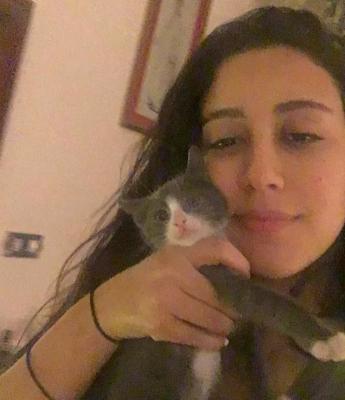
CAIRO –When a strong #MeToo movement hit Egypt’s internet in July, Nazli Mustafa Karim, 23, finally felt safe to come forward and support a young woman who had been a victim of gang-rape. The victim, whose anonymity is protected by a new Egyptian law, was drugged, raped, and filmed by a group of wealthy men in April 2014 in a room at Cairo’s Fairmont Hotel. One of the accused rapists is Nazli’s ex-husband, Amr Faris El Komy, with whom she had a 10-year relationship and was married to until 2018.
Nazli and the Fairmont victim were encouraged to speak about the incident after a 22-year-old Egyptian student named Ahmed Bassam Zaki was detained by the police for sexually assaulting and blackmailing over 100 women.
Because Zaki’s detention and recent conviction to three years in prison were a direct result of online activism, the two women looked for support from influential Egyptian feminists on social media to strengthen their case against the accused rapists.
One of the first to hear their story was women’s rights activist and writer Sabah Khodir, who moved from Cairo to the United States a few years ago after being a victim of sexual assault.
“They came to me because they felt I was not going to back away from them and would be able to help,” Sabah told the Insider. “Honestly, it was a very scary situation. The men involved are people with so much money.”
Sabah soon realized the Egyptian feminist movement was about to face a much more complicated case than that of Zaki. The Fairmont incident was not an isolated episode. At least six women have testified to being sexually assaulted by the same group in the past 10 years.
The victims were not picked at random. Initially, they were girls and young women out of the accused men’s social circle who had less money and less social power than them. Later, in order to challenge themselves, they started choosing women from their own community as well as models and women who were part of the pageant industry, witnesses have disclosed.
All these women had one thing in common. They all had experienced trauma and therefore were judged to be easy to manipulate – including Nazli, who lost her father at the age of four.
According to different witnesses, the group's victims were constantly beaten into doing drugs and partying. During and after the assaults, the men would also behave as a cult, where they would stamp their victims by writing their initials on their bodies, whether by forcing the girls to get tattoos or by writing their names with a pen or a marker. This was the case of the Fairmont victim, whose assault’s footage, recorded by the accused rapists, shows them signing their initials on her body after raping her.
Throughout August 2020, Egyptian activists flooded the internet with information about the Fairmont case, including the identity of nine men believed to be part of the group. As news spread, screenshots and voice recordings of threats received by the victims and the witnesses started to surface. Among them, there were voice messages from Amr Faris El Komy to Nazli, which shocked the activists and put everyone on a state of alert.
“The voice notes of him threatening her were one of the most grotesque things I have ever heard in my lifetime,” said Sabah. “Nazli was then reading the comments [on an online post that reproduced the message] and wrote me saying, ‘Is it really that bad?’ and I was like, ‘Yes, it’s awful, Nazli.’ And she said, ‘I was so used to this, I don’t even feel that’s so bad. He’s done and said so much worse.’”
During the 10-year relationship with El Komy, Nazli was subjected to constant threats, cursing, beating, and torture, according to people close to her and to her family. As people supporting the accused rapists believed she was giving out information about her ex-husband and his group as a way of seeking revenge, she became the main target of constant intimidation.
Days after receiving the voice notes, she received other threatening text messages from El Komy, where he said he knew she was the one behind the exposure of the case and that, at the end, she would find herself behind bars for that, not him. Nazli spoke up about the new threats on her personal Facebook account and told people that she was not safe.
Soon, private and intimate photos of her were leaked and her face and body were all over social media. Photos in a bikini, intimate videos, and a photo with a rainbow flag behind her were used to slut shame her and accuse her of promoting debauchery, which is a crime against family and religious values according to the Egyptian law.
On Aug.28 she was detained for questioning by the police along with at least five other witnesses in the Fairmont case. Some of them were released five days later. Three of them, however, remained in prison -- Nazli, Seif Bedour, and Ahmed El Ganzoury.
Bedour, who was a teenager at the time of the Fairmont crime and was not present in the hotel when the crime happened, was not part of the list of witnesses. He was friends with one of the witnesses and went with her to the police station on the day of her hearing so she wouldn’t be alone.
For reasons that have not been officially clarified, he had his phone confiscated and searched. Private photos of him were then used to justify his detention.
El Ganzoury, who was being questioned for organizing an event that the accused rapists attended hours before sexually assaulting the victim, also had his phone searched by the authorities.
According to information made public by people campaigning for their release, both Bedour and El Ganzoury were being accused of drug abuse and debauchery.
Nazli and Bedour were finally released from prison Jan.8, after 133 days of detention. On Jan. 23, the Egyptian Public Prosecution also announced on an official Facebook page the release of El Ganzoury.
A psychological report by psychiatrist Dr. Nabil El Kott, who was allowed to see Nazli in prison at least twice, stresses that she needs intensive psychological care as her condition might lead to self-injury or suicide.
The Insider contacted representatives of different Egyptian mental health platforms on social media which have been campaigning for women’s mental health since the beginning of the country’s #MeToo movement. Two of them agreed to speak to the Insider about Nazli’s case, but ended up interrupting communication without making any comments.
A representative of another platform, when asked if a professional therapist would agree to speak about the case, answered, “I’m not entirely sure about someone who would be so courageous.”
When it comes to her story, this is not an unusual remark. Ever since Nazli's detention, loud voices that were speaking about the Fairmont incident on social media fell silent, including pages who initially campaigned for victims and witnesses to come forward with the truth.
“Everyone is afraid of touching Nazli’s case. They find it like a suicide mission,” said Sabah Khodir.
Egypt’s feminist movement rapidly became polarized. On one side, there were those few people who felt it was necessary to speak about Nazli and campaign for her release; on the other, there were those who felt the topic was too problematic and risky to talk about.
Sabah chose the first side and soon became one of the only activists advocating for Nazli’s rights. In November, she went live on her Instagram account to discuss the case and was surprised to see that, although Nazli had been in prison for three months at that point, most of the people watching her transmission still didn’t know the circumstances under which Nazli, Seif, and El Ganzoury were detained.
Sabah’s determination to shed light on this case regardless of people’s fear has left her vulnerable to attacks. She has been a victim of intimidation from people who defend the accused rapists and, surprisingly, from other activists.
“It is scary to campaign for something like this and I understand that there are people who are scared, but fear is contagious and in a movement like this, I cannot be constantly led by fear or I won’t be very good at leading at all,” she said.
For Sabah, Egyptian feminists should acknowledge that the true icon behind 2020’s feminist movement is Nazli. “The person whose picture should be on everything when it comes to women empowerment is her. She risked everything. She should be the person everybody claps for, that we speak for.”
All nine men accused of being part of the group that gang-raped the Fairmont victim tried to flee the country when their names went viral on social media, except for one, who couldn’t flee because of his army duties. Three of these men – Ahmed Toulan, Khaled Mahmoud, and Amr Hussein – were captured in Lebanon and extradited back to Egypt by Interpol.
In total, five men were detained while four are still hiding outside of the country. Amr Faris El Komy, Nazli’s ex-husband, is still on the run. He is believed to be hiding in Europe.
jp-ms
Copyright The Italian Insider, unauthorised reproduction forbidden.