

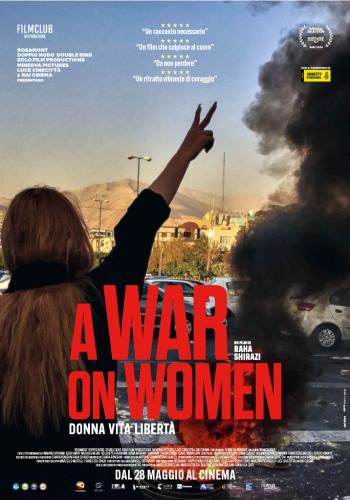
Review: A War on Women

ROME -- A War on Women, the new documentary film by Iranian-Canadian director and writer, Raha Shirazi, takes us beyond the attention-grabbing headlines of the current war in Iran to understand both the history and context of a powerful and ongoing resistance to the current regime. Along with her co-writer, Samira Mohyeddin, Shirazi captures a 50-year feminist movement that simultaneously exposes the brutality and generational trauma caused by state-sponsored patriarchy along with the incredible and inextinguishable courage of the women who refuse to accept perpetual discrimination.
Inspired by a precise memory from Shirazi’s childhood when she was denied entrance into a hotel for not being adequately dressed—meaning hair exposed without the ubiquitous veil (il velo)—the film is also a devastating love-letter to a country to which most of the women involved in the production cannot safely return. Shirazi’s own mother, Parvin, would never see Iran again after immigrating with her 10-year-old daughter to Canada.
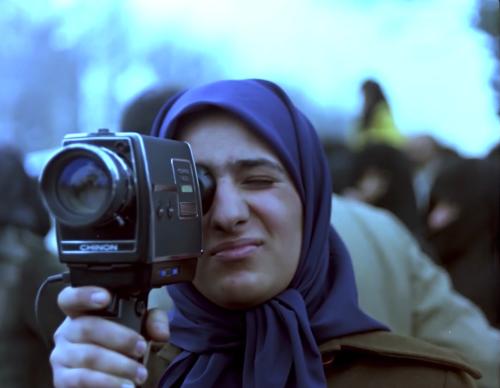
One of the film’s tremendous accomplishments is collecting a unique and difficult archive of material that transports the audience from the 1960s through contemporary Iran, mixing documentary footage from a range of original sources such as the Italian state-run fascist Istituto Luce to abundant footage from everyday Iranian women participating in the White Wednesdays movement against mandatory veils. A War on Women provides a veritable history lesson on how the current political climate has led to a devastating moment where American and Israeli forces attempt to bomb a regime into submission that has only served to endanger the lives of those most willing to resist from within.
There is so much to say about this film, because the scope is at once far-reaching and precisely quotidian. It is a rare opportunity to witness from outside—a privileged position to be sure—what has contributed over decades to a socio-political context of fear, inequality, and brazen suppression of human rights. These are things we might think we “know” in the abstract, but here is a sharply focused lens into what is happening on the ground. Even when it is hard to watch, there is beauty in telling such a visceral truth.
The story, as much as there is a narrative arc, is shaped by interviews with seven determined and exiled women. While the narrative does occasionally drift in a manner that can disorient the viewer, I found the technique valid within the frame of the film. Why shouldn’t we be hard-pressed at times to follow a story that is so layered across generations of resistance, constantly being upended through turmoil, exploitation, and regimental control? We always come back to the voices of these seven women, ranging from everyday activists to movement-defining leaders, who do not fail to remind us of the stakes of such a vicious cycle of oppression.
Some of the most striking lines of the film come from Golshifteh Farahani, a widely-popular movie star who fled Iran because she feared for her safety after a film she made with Ridley Scott (Body of Lies), who spoke about the impact of the regime’s misogyny. “Nobody tells you,” she says about women being lesser than a man in Iran, “Nobody teaches you. You just know…. It felt so normal. It didn’t traumatize me. This trauma was me.”
A War on Women is currently released and playing in theatres around Rome and Italy. The running time is 1h40’ and accompanied by a fantastic soundtrack. This film is not to be missed.
aos khg
© COPYRIGHT ITALIAN INSIDER
UNAUTHORISED REPRODUCTION FORBIDDEN